

Created for composers, arrangers, orchestrators, and teachers to quickly reference the written and sounding ranges to ALL instruments and ensembles you could write for!
Sold in full set, bundles and individual charts!
FULL SETS

The “Davis Keyboard Orchestration Charts (Complete Set of 22)” digital download includes 2 sets (44 in total) (1 “Full Bleed” for digital use and 1 with “Crop Marks” for the possibility of printing and laying on the keyboard behind the black keys). The Orchestration Charts were created for composers, arrangers, orchestrators and teachings to be able to visually see the ranges of other instruments on the piano (while composing or teaching). The charts have been mapped to the size of the standard piano keyboard so that you can also have them printed (some double sided), at a local print shop, to lay behind the black keys (or you can reference them digitally!).
These charts show the limits/ranges of other the written range (front) and sounding range (back) of all transposing instruments, so you can quickly reference them, to see if your melody or harmony fits within the ranges of the instruments you are writing for. Never be confused with transpositions again! This new tool is a MUST HAVE for every composer!
The Full Set includes:
1-Voice
2-Strings
3-Brass (written range)
4-Brass (sounding range)
5-Saxophones (written range)
6-Saxophones (sounding range)
7-Clarinets (written range)
8-Clarinets (sounding range)
9-Flutes (written range)
10-Flutes (sounding range)
11-Winds (written range)
12-Winds (sounding range)
13-Percussion (written range)
14-Percussion (sounding range)
15-Keyboards (written range)
16-Keyboards (sounding range)
17-Guitars (written range)
18-Guitars (sounding range)
19-Others 1 (written range)
20-Others 1 (sounding range)
21-Others 2 (written range)
22-Others 2 (sounding range)
SETS & BUNDLES

The “Davis Keyboard Orchestration Charts Brass & Woodwinds (Set of 10)” digital download includes 2 sets (20 in total) (1 “Full Bleed” for digital use and 1 with “Crop Marks” for the possibility of printing and laying on the keyboard behind the black keys). The Orchestration Charts were created for composers, arrangers, orchestrators and teachings to be able to visually see the ranges of other instruments on the piano (while composing or teaching). The charts have been mapped to the size of the standard piano keyboard so that you can also have them printed (some double sided), at a local print shop, to lay behind the black keys (or you can reference them digitally!).
These charts show the limits/ranges of other the written range (front) and sounding range (back) of all transposing instruments, so you can quickly reference them, to see if your melody or harmony fits within the ranges of the instruments you are writing for. Never be confused with transpositions again! This new tool is a MUST HAVE for every composer!
The Brass & Woodwinds Set Includes:
3-Brass (written range)
4-Brass (sounding range)
5-Saxophones (written range)
6-Saxophones (sounding range)
7-Clarinets (written range)
8-Clarinets (sounding range)
9-Flutes (written range)
10-Flutes (sounding range)
11-Winds (written range)
12-Winds (sounding range)

The “Davis Keyboard Orchestration Charts ‘Voice, Strings, & Percussion’ (Set of 12)” digital download includes 2 sets (24 in total) (1 “Full Bleed” for digital use and 1 with “Crop Marks” for the possibility of printing and laying on the keyboard behind the black keys). The Orchestration Charts were created for composers, arrangers, orchestrators and teachings to be able to visually see the ranges of other instruments on the piano (while composing or teaching). The charts have been mapped to the size of the standard piano keyboard so that you can also have them printed (some double sided), at a local print shop, to lay behind the black keys (or you can reference them digitally!).
These charts show the limits/ranges of other the written range (front) and sounding range (back) of all transposing instruments, so you can quickly reference them, to see if your melody or harmony fits within the ranges of the instruments you are writing for. Never be confused with transpositions again! This new tool is a MUST HAVE for every composer!
The ‘Voice, Strings, & Percussion Set’ Includes:
1-Voice
2-Strings
13-Percussion (written range)
14-Percussion (sounding range)
15-Keyboards (written range)
16-Keyboards (sounding range)
17-Guitars (written range)
18-Guitars (sounding range)
19-Others 1 (written range)
20-Others 1 (sounding range)
21-Others 2 (written range)
22-Others 2 (sounding range)
INDIVIDUAL CHARTS

These Davis Keyboard Orchestration Charts show the written ranges, and sounding ranges, of standard Keyboard & Plucked Stringed instruments- Guitar, Celeste, Piano Accordion, Organ, Harp, and Piano (written and sounding range). The charts were written so you can quickly reference the ranges, to see if your melody or harmony fits within the ranges of common Keyboard & Plucked Stringed instruments and ensembles (ie. Harp and Guitar, Piano and Celeste, etc.). This new tool is a MUST HAVE for every composer!
The “Davis Keyboard Orchestration Charts ‘Percussion’ (2 Charts)” digital download includes 2 sets (4 in total) (1 “Full Bleed” for digital use and 1 with “Crop Marks” for the possibility of printing and laying on the keyboard behind the black keys). The Orchestration Charts were created for composers, arrangers, orchestrators and teachings to be able to visually see the ranges of other instruments on the piano (while composing or teaching). The charts have been mapped to the size of the standard piano keyboard so that you can also have them printed (some double sided), at a local print shop, to lay behind the black keys (or you can reference them digitally!).
The Charts Included:
15-Keyboard & Plucked Strings (written range)
16-Keyboards & Plucked Strings (transposing range)

This Davis Keyboard Orchestration Chart shows the limits/ranges of a standard choir - SATBB or Soprano, Alto, Tenor, Baritone, and Bass. The chart was written so you can quickly reference the ranges, to see if your melody or harmony fits within the ranges of the choir you are writing for. This new tool is a MUST HAVE for every composer!
The “Davis Keyboard Orchestration Charts ‘Voice - SATBB’ (1 Chart)” digital download includes 2 sets (2 in total) (1 “Full Bleed” for digital use and 1 with “Crop Marks” for the possibility of printing and laying on the keyboard behind the black keys). The Orchestration Charts were created for composers, arrangers, orchestrators and teachings to be able to visually see the ranges of other instruments on the piano (while composing or teaching). The charts have been mapped to the size of the standard piano keyboard so that you can also have them printed (some double sided), at a local print shop, to lay behind the black keys (or you can reference them digitally!).
The Charts Included:
1-Voice

This Davis Keyboard Orchestration Chart shows the limits/ranges of a standard string orchestra - violin, viola, cello and double bass. The chart was written so you can quickly reference the ranges, to see if your melody or harmony fits within the ranges of the string orchestra, string quartet, or string trio you are writing for. This new tool is a MUST HAVE for every composer!
The “Davis Keyboard Orchestration Charts ‘Strings’ (1 Chart)” digital download includes 2 sets (2 in total) (1 “Full Bleed” for digital use and 1 with “Crop Marks” for the possibility of printing and laying on the keyboard behind the black keys). The Orchestration Charts were created for composers, arrangers, orchestrators and teachings to be able to visually see the ranges of other instruments on the piano (while composing or teaching). The charts have been mapped to the size of the standard piano keyboard so that you can also have them printed (some double sided), at a local print shop, to lay behind the black keys (or you can reference them digitally!).
The Charts Included:
2-Strings
These Davis Keyboard Orchestration Charts show the written ranges, and sounding ranges, of standard brass instruments- Trumpet & Cornet, Trombone & Euphonium, French Horn, and Tuba. The charts were written so you can quickly reference the ranges, to see if your melody or harmony fits within the ranges of common brass instruments and ensembles. This new tool is a MUST HAVE for every composer!
The “Davis Keyboard Orchestration Charts ‘Brass’ (2 Charts)” digital download includes 2 sets (4 in total) (1 “Full Bleed” for digital use and 1 with “Crop Marks” for the possibility of printing and laying on the keyboard behind the black keys). The Orchestration Charts were created for composers, arrangers, orchestrators and teachings to be able to visually see the ranges of other instruments on the piano (while composing or teaching). The charts have been mapped to the size of the standard piano keyboard so that you can also have them printed (some double sided), at a local print shop, to lay behind the black keys (or you can reference them digitally!).
The Charts Included:
3-Brass (written range)
4-Brass (transposing range)
These Davis Keyboard Orchestration Charts show the written ranges, and sounding ranges, of standard saxophones- Soprano, Alto, Tenor, Baritone and Bass (written and sounding range). The charts were written so you can quickly reference the ranges, to see if your melody or harmony fits within the ranges of common saxophone instruments and ensembles (ie. saxophone quartets). This new tool is a MUST HAVE for every composer!
The “Davis Keyboard Orchestration Charts ‘Saxophones’ (2 Charts)” digital download includes 2 sets (4 in total) (1 “Full Bleed” for digital use and 1 with “Crop Marks” for the possibility of printing and laying on the keyboard behind the black keys). The Orchestration Charts were created for composers, arrangers, orchestrators and teachings to be able to visually see the ranges of other instruments on the piano (while composing or teaching). The charts have been mapped to the size of the standard piano keyboard so that you can also have them printed (some double sided), at a local print shop, to lay behind the black keys (or you can reference them digitally!).
The Charts Included:
5-Saxophones (written range)
6-Saxophones (transposing range)
These Davis Keyboard Orchestration Charts show the written ranges, and sounding ranges, of standard Clarinets- E-Flat, B-Flat (Soprano), Alto, Bass, and Contrabass Clarinets (written and sounding range). The charts were written so you can quickly reference the ranges, to see if your melody or harmony fits within the ranges of common clarinet instruments and ensembles (ie. clarinet quartets). This new tool is a MUST HAVE for every composer!
The “Davis Keyboard Orchestration Charts ‘Clarinets’ (2 Charts)” digital download includes 2 sets (4 in total) (1 “Full Bleed” for digital use and 1 with “Crop Marks” for the possibility of printing and laying on the keyboard behind the black keys). The Orchestration Charts were created for composers, arrangers, orchestrators and teachings to be able to visually see the ranges of other instruments on the piano (while composing or teaching). The charts have been mapped to the size of the standard piano keyboard so that you can also have them printed (some double sided), at a local print shop, to lay behind the black keys (or you can reference them digitally!).
The Charts Included:
7-Clarinets (written range)
8-Clarinets (transposing range)
These Davis Keyboard Orchestration Charts show the written ranges, and sounding ranges, of standard Flutes- Piccolo, Flute, Alto Flute, and Bass Flute (written and sounding range). The charts were written so you can quickly reference the ranges, to see if your melody or harmony fits within the ranges of common clarinet instruments and ensembles (ie. clarinet quartets). This new tool is a MUST HAVE for every composer!
The “Davis Keyboard Orchestration Charts ‘Flutes’ (2 Charts)” digital download includes 2 sets (4 in total) (1 “Full Bleed” for digital use and 1 with “Crop Marks” for the possibility of printing and laying on the keyboard behind the black keys). The Orchestration Charts were created for composers, arrangers, orchestrators and teachings to be able to visually see the ranges of other instruments on the piano (while composing or teaching). The charts have been mapped to the size of the standard piano keyboard so that you can also have them printed (some double sided), at a local print shop, to lay behind the black keys (or you can reference them digitally!).
The Charts Included:
9-Flutes (written range)
10-Flutes (transposing range)
The “Davis Keyboard Orchestration Charts ‘Winds’ (2 Charts)” digital download includes 2 sets (4 in total) (1 “Full Bleed” for digital use and 1 with “Crop Marks” for the possibility of printing and laying on the keyboard behind the black keys). The Orchestration Charts were created for composers, arrangers, orchestrators and teachings to be able to visually see the ranges of other instruments on the piano (while composing or teaching). The charts have been mapped to the size of the standard piano keyboard so that you can also have them printed (some double sided), at a local print shop, to lay behind the black keys (or you can reference them digitally!).
These charts show the written ranges, and sounding ranges, of standard Wind instruments- Piccolo, Flute, Alto Flute, Bass Flute, Oboe D’amore, Oboe, English Horn, Clarinet, Bass Clarinet, Bassoon, and Contra Bassoon (written and sounding range). The charts were written so you can quickly reference the ranges, to see if your melody or harmony fits within the ranges of common wind instruments and ensembles (ie. wind quintet, wind band, etc.). This new tool is a MUST HAVE for every composer!
The Charts Included:
11-Winds (written range)
12-Winds (transposing range)
These Davis Keyboard Orchestration Charts show the written ranges, and sounding ranges, of standard Percussion instruments- Crotales, Chimes, Glockenspiel, Vibraphone, Xylophone, Marimba, and Timpani (written and sounding range). The charts were written so you can quickly reference the ranges, to see if your melody or harmony fits within the ranges of common percussion instruments and ensembles (ie. marimba quartet, etc.). This new tool is a MUST HAVE for every composer!
The “Davis Keyboard Orchestration Charts ‘Percussion’ (2 Charts)” digital download includes 2 sets (4 in total) (1 “Full Bleed” for digital use and 1 with “Crop Marks” for the possibility of printing and laying on the keyboard behind the black keys). The Orchestration Charts were created for composers, arrangers, orchestrators and teachings to be able to visually see the ranges of other instruments on the piano (while composing or teaching). The charts have been mapped to the size of the standard piano keyboard so that you can also have them printed (some double sided), at a local print shop, to lay behind the black keys (or you can reference them digitally!).
The Charts Included:
13-Percussion (written range)
14-Percussion (transposing range)
These Davis Keyboard Orchestration Charts show the written ranges, and sounding ranges, of standard Guitar & Plucked Stringed instruments- Cavaquinho, Ukelele, Banjo, Mandolin, Acoustic/Electric Guitar, Bass Guitar, and Contrabass Guitar Guitar (written and sounding range). The charts were written so you can quickly reference the ranges, to see if your melody or harmony fits within the ranges of common Guitar & Plucked Stringed instruments and ensembles (ie. Guitar Ensemble, Guitar & Mandolin, etc.). This new tool is a MUST HAVE for every composer!
The “Davis Keyboard Orchestration Charts ‘Guitars’ (2 Charts)” digital download includes 2 sets (4 in total) (1 “Full Bleed” for digital use and 1 with “Crop Marks” for the possibility of printing and laying on the keyboard behind the black keys). The Orchestration Charts were created for composers, arrangers, orchestrators and teachings to be able to visually see the ranges of other instruments on the piano (while composing or teaching). The charts have been mapped to the size of the standard piano keyboard so that you can also have them printed (some double sided), at a local print shop, to lay behind the black keys (or you can reference them digitally!).
The Charts Included:
17-Guitars (written range)
18-Guitars (transposing range)
These Davis Keyboard Orchestration Charts show the written ranges, and sounding ranges, of less common instruments- Ocarina, Hurdy-Gurdy, Toy Piano, Bagpipes, Hammered Dulcimer, Harmonica, and Lute (written and sounding range). The charts were written so you can quickly reference the ranges, to see if your melody or harmony fits within the ranges of less common instruments and ensembles (ie. Bagpipe Ensemble, Lute & Hammered Dulcimer, etc.). This new tool is a MUST HAVE for every composer!
The “Davis Keyboard Orchestration Charts ‘Guitars’ (2 Charts)” digital download includes 2 sets (4 in total) (1 “Full Bleed” for digital use and 1 with “Crop Marks” for the possibility of printing and laying on the keyboard behind the black keys). The Orchestration Charts were created for composers, arrangers, orchestrators and teachings to be able to visually see the ranges of other instruments on the piano (while composing or teaching). The charts have been mapped to the size of the standard piano keyboard so that you can also have them printed (some double sided), at a local print shop, to lay behind the black keys (or you can reference them digitally!).
The Charts Included:
19-Others, Random & Ethnic #1 (written range)
20-Others, Random & Ethnic #1 (transposing range)
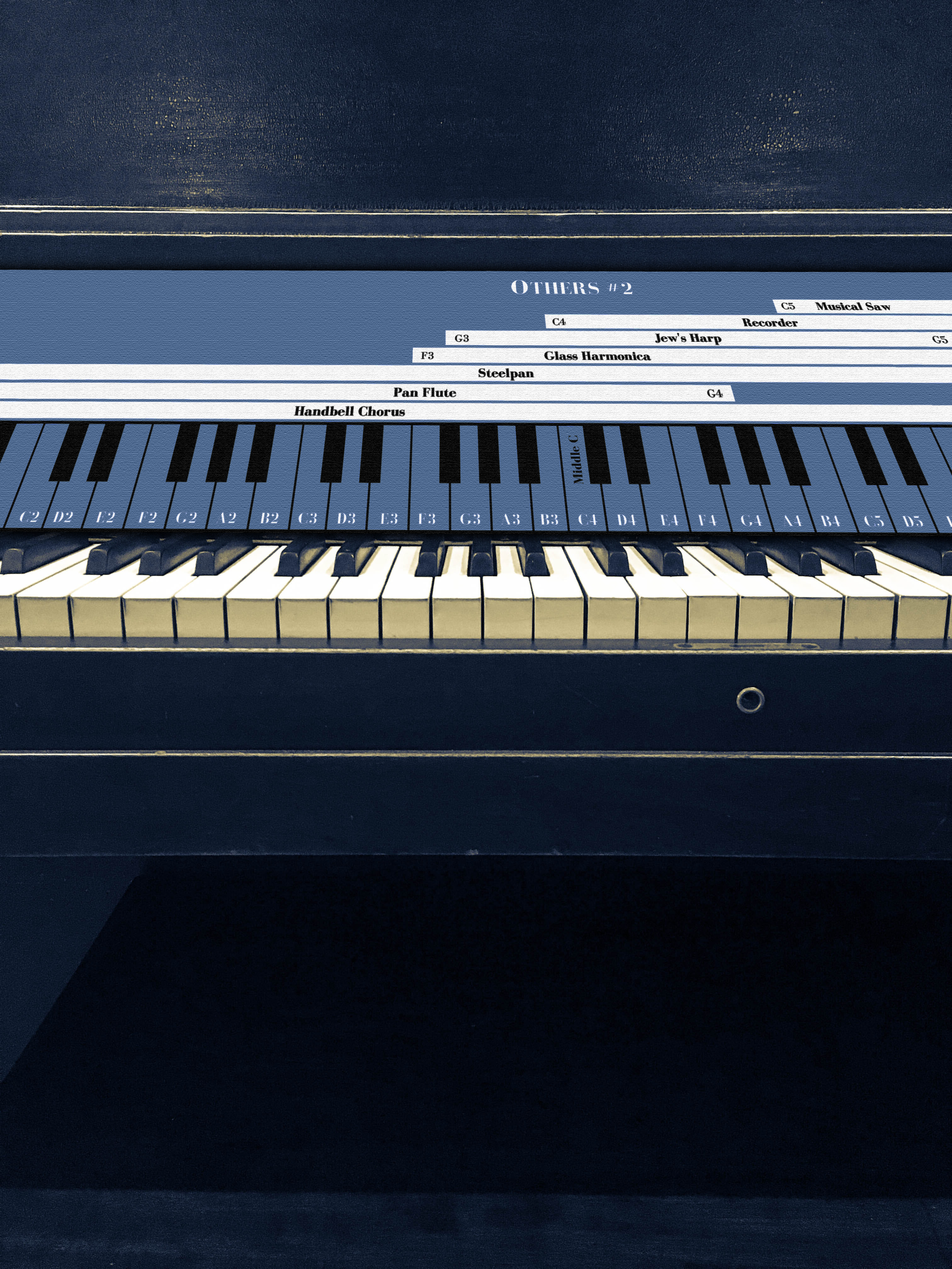
These Davis Keyboard Orchestration Charts show the written ranges, and sounding ranges, of less common instruments- Musical Saw, Recorder, Jew’s Harp, Glass Harmonica, Steelpan, Pan Flute, Handbell Chorus (written and sounding range). The charts were written so you can quickly reference the ranges, to see if your melody or harmony fits within the ranges of less common instruments and ensembles (ie. Steelpan Ensemble, Handbell Chorus, etc.). This new tool is a MUST HAVE for every composer!
The “Davis Keyboard Orchestration Charts ‘Guitars’ (2 Charts)” digital download includes 2 sets (4 in total) (1 “Full Bleed” for digital use and 1 with “Crop Marks” for the possibility of printing and laying on the keyboard behind the black keys). The Orchestration Charts were created for composers, arrangers, orchestrators and teachings to be able to visually see the ranges of other instruments on the piano (while composing or teaching). The charts have been mapped to the size of the standard piano keyboard so that you can also have them printed (some double sided), at a local print shop, to lay behind the black keys (or you can reference them digitally!).
The Charts Included:
21-Others, Random & Ethnic #2 (written range)
22-Others, Random & Ethnic #2 (transposing range)